Markéta Hermanová, Aleš Hudeček – We Could Die for Tonight
15. 09. 2026 - 15. 11. 2026
Galerie Dukla / Ostrava – Poruba
Ostrava – Poruba
Exhibitions

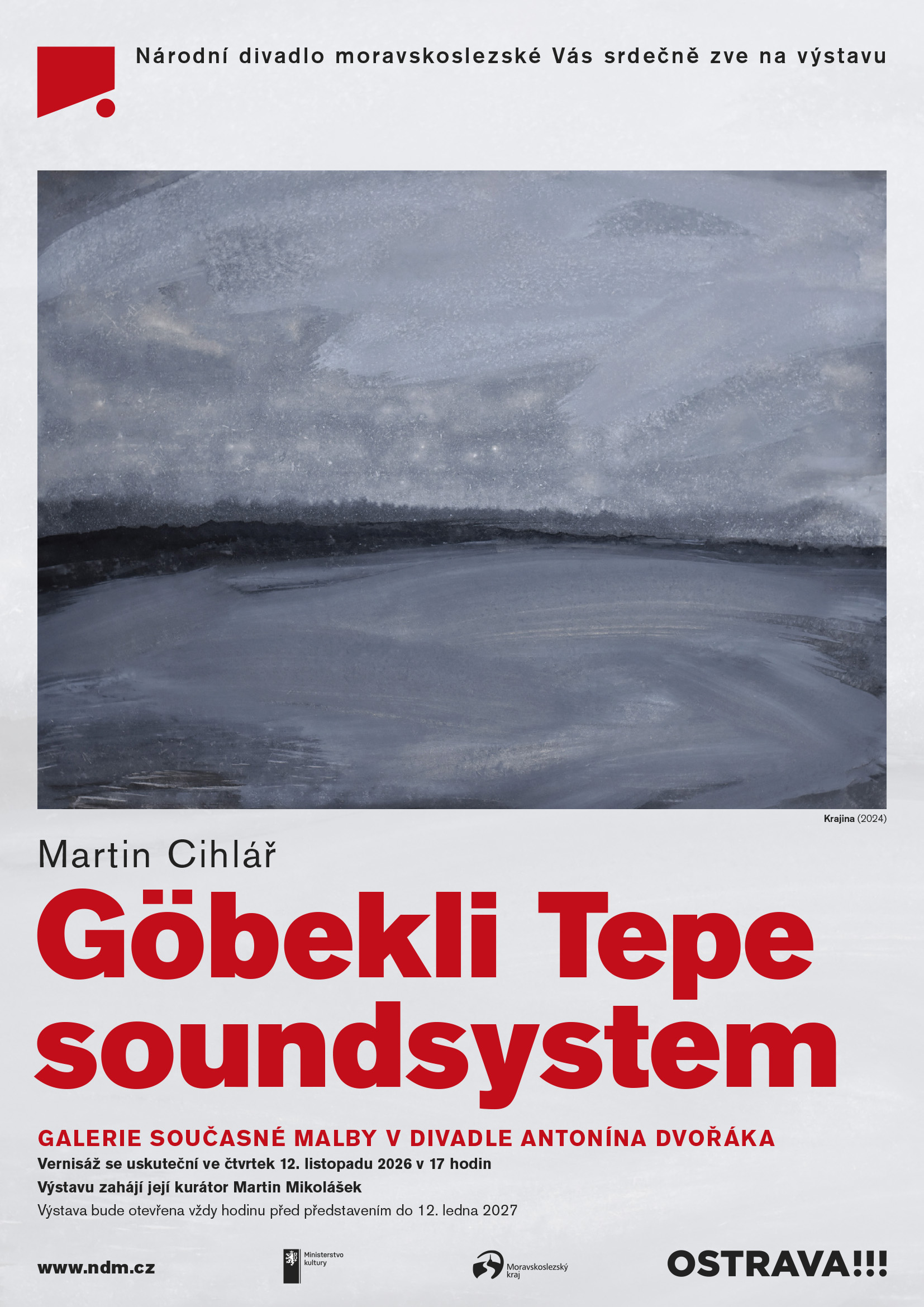
The Gallery of Contemporary Painting at the Antonín Dvořák Theater will present, from November through January, the work of Martin Cihlář (*1986), an artist who exhibits only sporadically. More than a decade ago, he graduated from Prof. Eduard Ovčáček’s graphic arts studio at the University of Ostrava. Although he studied graphic design, he devoted himself at that time to composing picture-objects made of Plexiglas, plastic sheeting, tulle, lace, needles, beads, and felt. He reduced the color palette in these works to shades of gray and black. This gave rise to a peculiar reversal of the original approaches; what might have mimicked mezzotint, an aquatint, or a lithograph, was in fact the result of a loose, even gestural painterly style—referencing, on the one hand, expressive-informel tendencies, and on the other, the postmodern language of arte povera (translated as “poor art”).
In his subsequent creative period, he abandoned the explicit use of trash materials and began to devote himself primarily to painting. However, he remains faithful to color reduction to this day. He embraces traditional genres—still lifes and landscapes—but in a manner that is thoroughly unconventional, free, and unbiased.
The exhibited series of night landscapes was created during a single summer week in a garage on the outskirts of Bohumín. He painted at night, often until dawn, playing music loudly; to apply the paint, he used broad, dried-out brushes as well as books: dictionaries, the Rules of Czech Spelling, textbooks, and, as he himself says, perhaps even the occasional play. The horizon, clouds, stars—the treatment of these motifs is simplified, basic, and thus evocative, yet at the same time somewhat eerie. Similarly to moths, whose images form the second part of the exhibition. The artist perceives their wings as peculiar, fascinating, and ever-changing projection surfaces, in which the motif of the moth (in Old Church Slavonic “mora”—demon, witch) becomes, above all, a symbol of ritualized transformation: the disconnection of the rational mind, symbolic death, and rebirth.
Curator: Martin Mikolášek