Dar Vladimíra Preclíka Královéhradeckému kraji
23. 05. 2025 - 31. 01. 2027
Gallery of Modern Art in Hradec Králové / Hradec Králové
Hradec Králové
Exhibitions

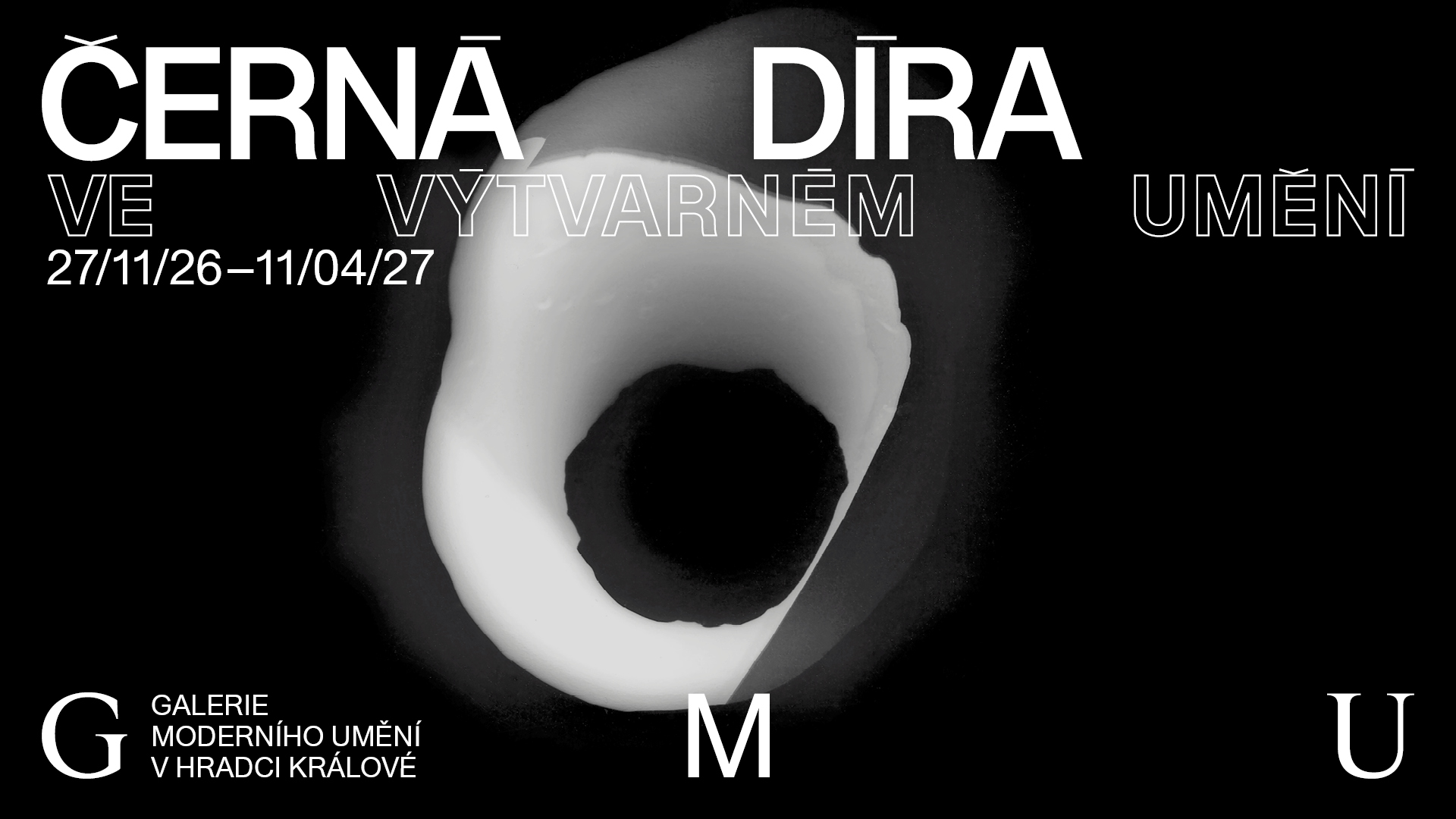
Cosmic black holes present a paradoxical subject. They are invisible objects from which not even light can escape, and therefore should not be visually representable. Nevertheless, artists continue to attempt to do so, using a wide range of techniques and approaches: from scientific and popular science illustrations, through paintings and sculptures, to photograms and installations. The exhibition presents this colorful history of black holes in Czech visual culture from the mid-20th century to the present.
Non-rotating black holes were discovered by astronomer Karl Schwarzschild as early as 1915 through his solution to Einstein’s equations. However, the scientific community did not truly begin to take an interest in these collapsed stars until half a century later. A key factor in this was the term “black hole,” which was popularized in the late 1960s by the American physicist John Archibald Wheeler.
This term quickly made its way into Czechoslovakia, which at the time, from an astrophysical perspective, was situated between the West and the East. Czech publications blended Anglo-Saxon terminology with Soviet terminology, and illustrations from American magazines appeared alongside images of Moscow origin. Consequently, in the 1970s, the term “black hole” coexisted in our country with other names such as “collapsar,” “frozen star,” or “gravitational grave”. The term “black hole” eventually prevailed, in part due to its psychological connotations—it soon became a metaphor for extinction or depression.
Although black holes themselves cannot, in principle, be seen, a multitude of highly visual processes take place in their vicinity that can be alluring to the visual arts. Among the most striking are the accretion disk, in which gas and dust are heated to millions of kelvins by rotation, and the massive jets of particles caused by magnetic fields. Phenomena invisible to the naked eye, such as the curvature of spacetime, can also be depicted.
However, it is important to remember that artists’ interest in black holes tends to be highly subjective. Whether it is an expression of somber emotion or a reflection on the interconnectedness of the universe, they choose this motif as a more general symbol and are not concerned with scientific accuracy. Such literalism would only be detrimental, as art historian Timothy James Clark prophetically put it: “Painting is rarely well nourished by the scraps of science.”
Curators: Tomáš Kolich, Petra Příkazská
Artists: Václav Boštík, Lukáš Dvorský, Jan Exnar, Lenka Falušiová, Jolana Havelková, Anna Hulačová, Josef Hnízdil, Milan Houser, Jan Kaláb, Miloš Koreček, Jiří Kornatovský, Antonín Kopp, Jean-Pierre Luminet, Karel Malich, Ivana Mikesková-Hejduková, Milan Mikuláštík, Pavel Mrkus, Pavel Nešleha, Robert V. Novák, Jan Pištěk, Jan Poš, Ladislav Postupa, Eva Prokopcová, Ondřej Přibyl, Rudolf Sikora, Vladimír Škoda, Dagmar Šubrtová, Katarína Štefániková, Bohumil Štěpán, Pavel Trnka, Andrea Uváčiková, Jasan Zoubek