1939–2021: Konec černobílé doby
26. 05. 2023 - 30. 06. 2030
Národní galerie Praha, Veletržní palác / Praha 7
Praha 7
Exhibitions

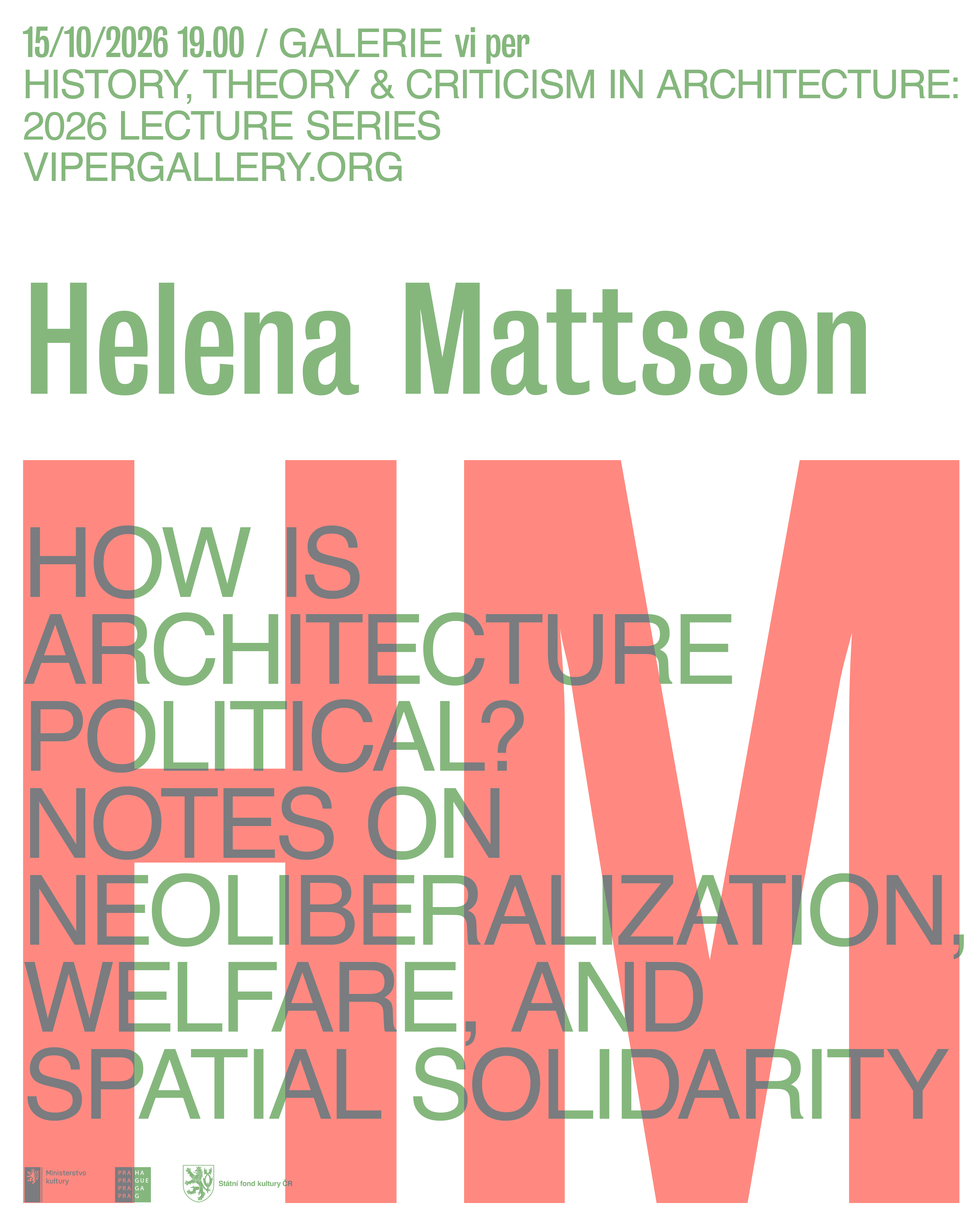
In the context of today’s polarized attitudes and violent conflicts—including the climate crisis, migration, housing shortages, and escalating economic and social inequalities—the call for politically and socially engaged architecture is urgent. The built environment was the cornerstone of the social contract of the 20th-century welfare state, but today the relationship between the state and the built environment is radically different. The role of architecture in social change is thus far from clear.
This lecture explores the influence of architecture in a changing political landscape, where the neoliberal agenda has radically altered the conditions for this discipline. I propose that we need to broaden our conception of architecture in order to uncover its role in social processes, critically analyze how architecture functions today, and, last but not least, foster new possibilities for bringing about change. The field of architecture encompasses legally established infrastructures, such as building codes and decision-making systems, but as neoliberalization has shown, it also encompasses shifts in mentality that define the value of architecture. I want to show why we must constantly reevaluate these determining mechanisms in order to question the role of this field, and how the history of architecture can offer fruitful inspiration for future changes.
Political and spatial deregulation within the framework of neoliberalization has made market logic the dominant principle of our time. I will speculate on a new creative bureaucracy and what it might bring to architecture as a discipline. The lecture will introduce the concept of radical bureaucracy, influenced by earlier work in full-scale laboratories led by women architects in the 1960s. The know-how developed in these laboratories was aimed at empowering users and gave a voice to groups that were often overlooked in commercial design and production processes.
Helena Mattsson is a professor of history and theory at the KTH School of Architecture. Her research focuses on modern history and the interconnections between politics, economics, and spatial arrangements. Her monograph *Architecture and Retrenchment: Neoliberalization of the Swedish Model Across Aesthetics and Space, 1968–1994* (Bloomsbury Visual Arts) was published in the spring of 2023. She is the co-editor of publications such as *Neoliberalism on the Ground* (Pittsburgh University Press, 2021), *Swedish Modernism: Architecture, Consumption, and the Welfare State* (2010), and a special issue of the journal *Architecture and Culture* titled “Architecture and Capitalism: Solids and Flows” (2017).