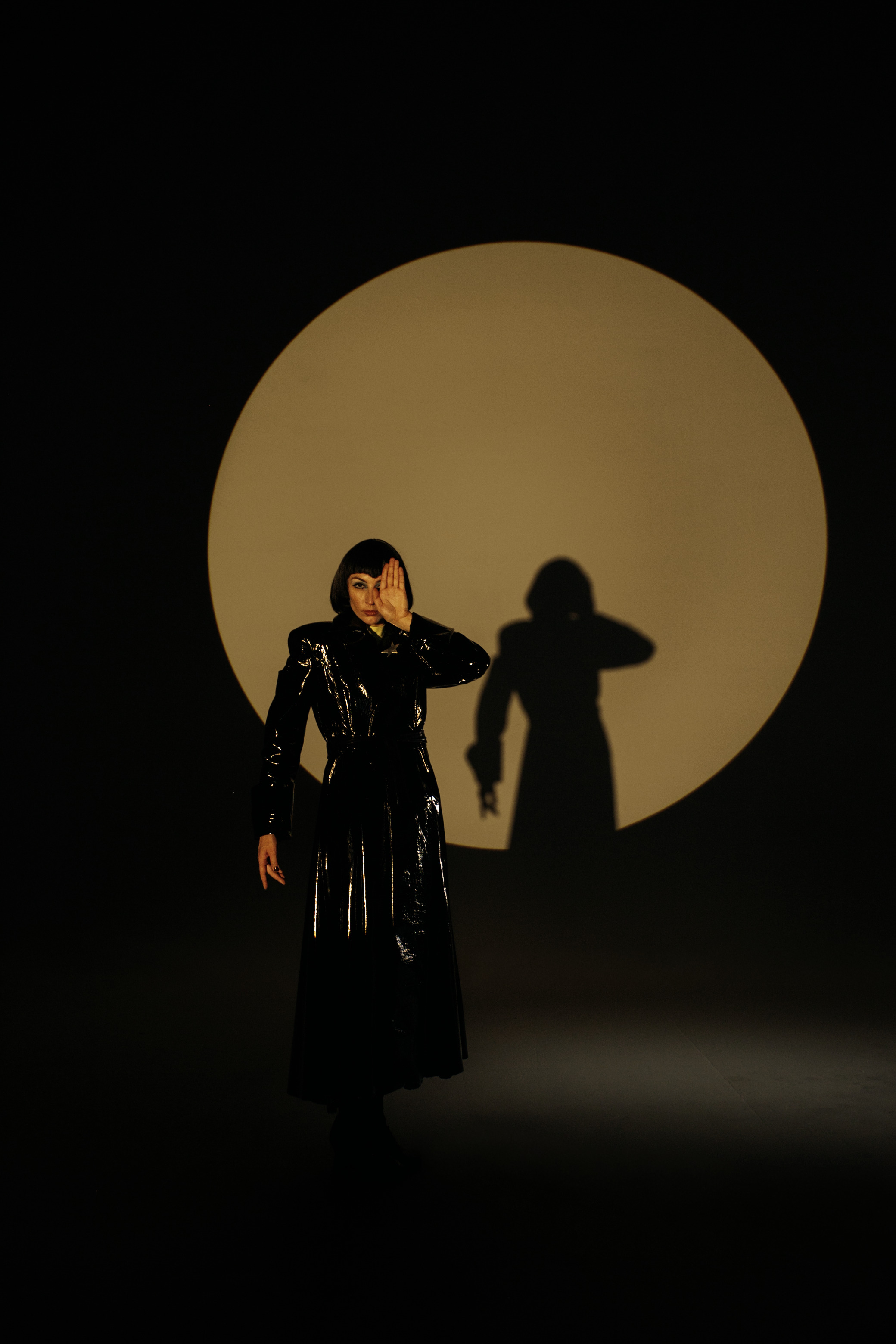
Valentýna Janů – Hold Your Keys Tight
22. 10. 2026 18:00
MeetFactory / Praha 5
Praha 5
Openings

100 CZK / 50 CZK
Exhibition Hold Your Keys Tight presents Valentýna Janů as an artist who has long explored the gestures, rhythms, and postures women and queer people use to create visibility in public space—and who now brings this question to the city at night, an environment where the body’s vulnerability and freedom intertwine most clearly.
The exhibition’s title refers to the subtle yet universally recognizable gesture of keys clenched between the fingers, a quiet self-defense strategy that many women adopt on their way home after dark—and which also serves as a reminder that the freedom to move about at night has never been equally shared.
The central element of the installation is a hybrid film, the concept for which was conceived during the artist’s residency at Pioneer Works in New York; the screenplay was subsequently developed at the LaunchPad residency in France, and filming took place in 2026 during a residency at the ISCP in New York. Its main character is a stylized heroine drawing on both noir aesthetics and the superheroine archetype; however, rather than assuming the role of a femme fatale—defined by the fascination of the male gaze—she defines her own individuality. She is portrayed in turn by several performers, and Keywoman thus becomes, rather than a portrait of a single woman, a mirror of collective experience. Her journey takes her through an apartment, the streets of nighttime New York, and the abstract darkness of the studio, and her movements critically reinterpret the historical figures of the flâneur and the nightwalker, for whom the freedom to roam the city was a given—but only from a male perspective.
The film combines a documentary texture with choreographically stylized sequences based on the filmmaker’s doctoral research into subcultural performative genres—such as drag, burlesque, and the ballroom scene—from which vogueing emerged—understood here as strategies of emancipation through which marginalized communities transform fear into a space of autonomy and mutual care. In passages where the image fades into darkness, sound takes on a guiding role: voices, breath, the rhythm of footsteps, the hum of the city, accounts of nighttime journeys, and original beats by Johannes Tröstler, who composes all these layers into a spatial, multi-channel mix.
At the Kostka Gallery, the film is set within a scenography that evokes the character of a nighttime street, where darkness itself becomes the medium of the installation. Here, darkness appears in its physical, symbolic, and psychological forms—as an immediate bodily experience of the night, as a metaphor for personal and social crises, and as a space to which the female experience has historically been relegated.


